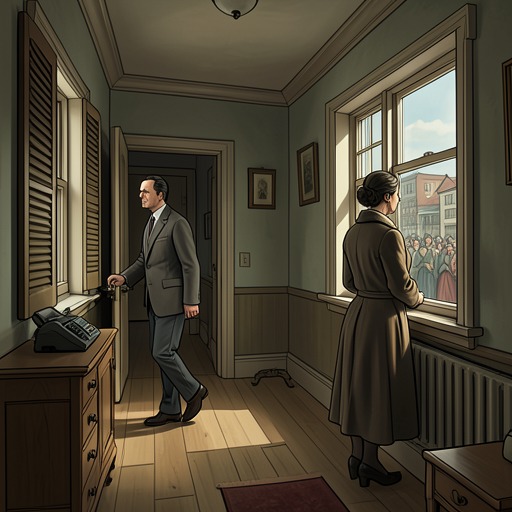
The battle in which Zhivago saves Seriozha Rantsevich
Doctor ZhivagoThe battle in which Yurii Andreievich Zhivago saves Seriozha Rantsevich turns a battlefield encounter into a test of medical duty, involuntary participation, and responsibility toward an enemy. Zhivago, held by the partisans and caught under fire, cannot preserve the detachment of a doctor: he takes up a dead telephonist’s rifle, fires while trying not to strike the advancing White volunteers, and later discovers that the young soldier he believed killed is alive. With Angelar’s help, he hides, treats, and ultimately releases him, though the young man intends to resume fighting for the opposing army.
Battlefield and divided loyalties
The Red Cross convention forbids army medical personnel from participating in the belligerents’ military operations. On this occasion, however, Zhivago is caught in the field when an engagement begins. At the edge of a forest, he lies beside a unit telephonist as the Whites attack across an open field. The medical rule establishes the conflict, but it cannot keep him outside the danger or the decisions taking place around him.
The attackers are a mixed force of young volunteers from the capital cities and older reservists. Many of the younger men are university students or senior pupils; although Zhivago does not recognize them, their faces evoke people from his own social and educational world. He sees them advance upright and in extended formation, exposing themselves rather than using the irregular ground for cover. The partisans, with limited ammunition and orders to fire only at close range and visible targets, shoot them down.
Zhivago’s sympathies lie with the young attackers. He wishes them success, regarding them as people whose families may share his own values and upbringing. He briefly considers running into the field and surrendering, but understands that either side might shoot him: the partisans could read his action as betrayal, while the Whites might misunderstand it. He rejects the escape as too dangerous and remains on the ground, watching the battle with divided loyalties.
From medical neutrality to participation
For Zhivago, remaining an observer becomes untenable not because he has changed allegiance, but because the immediate situation draws him into its actions. As the combatants around him are fired upon, he feels he must respond to the event rather than maintain the fiction of being an outsider. When the telephonist beside him is killed, Zhivago crawls over, takes the man’s rifle and cartridge bag, returns to his position, and fires repeatedly.
He cannot bring himself to aim at the young men he admires. Nor does he see firing harmlessly into the air as a meaningful alternative. Instead, he shoots at a blasted tree, choosing moments when no attacker is between his sights and the target. His practiced method of firing lets him direct the shots toward the dead branches, which break away. The scene makes his divided position concrete: he has taken up a weapon and joined the exchange of fire, yet attempts to keep his sympathy from becoming a deliberate attack on the people advancing against him.
The separation between intention and consequence does not hold. Two of the young attackers are wounded, and one who falls near the tree appears to Zhivago to have been killed. The White command eventually orders a retreat, judging the attack futile. The partisans do not pursue: their numbers are small, some of their main force is away, and another detachment is engaged elsewhere. The immediate fighting ends without resolving the moral burden of Zhivago’s participation.
Seriozha’s survival and rescue
After the engagement, Zhivago leaves the telephonist and goes into the field to the fallen White soldier. The young man’s face makes the consequence of firing personal to him, and Zhivago asks himself why he killed him. He opens the boy’s coat and finds the name Seriozha Rantsevich carefully embroidered on its lining, probably by his mother. A cross, locket, and small gold case hang from a chain, and a paper bears the Ninety-first Psalm in its complete Slavonic text.
Seriozha groans and stirs. He has been stunned and sustained a slight internal injury, but is alive; the bullet was stopped by his mother’s amulet. In the prevailing violence, enemy prisoners often do not reach headquarters alive, and wounded opponents may be killed where they fall. The discovery therefore changes the question from whether Zhivago has killed the young man to whether he can protect him from what capture would mean.
The partisan force’s frequent movement of deserters between the opposing sides gives Zhivago a narrow way to act. If secrecy is maintained, Seriozha can be represented as a newly enlisted ally. Zhivago confides in Angelar, and together they exchange the dead telephonist’s outer clothing for the boy’s, disguising his identity within the partisan ranks. They nurse him back to health. Once well, Seriozha is released; he makes no secret that he intends to return to Kolchak’s army and continue fighting the Reds.
Significance of the encounter
The rescue does not convert Seriozha to Zhivago’s cause or end their conflict. Its outcome is more limited and, for that reason, more revealing: Zhivago saves a wounded opponent without claiming that the opponent has become a friend or that the war has been settled. Seriozha leaves free to return to the army he had been fighting for, while Zhivago’s action protects an individual life across the divisions imposed by the battle.
The amulet and the embroidered name focus the encounter on the young soldier as someone known and cherished beyond the opposing uniform. Zhivago first encounters him as a target at a distance, then as a fallen figure whose face prompts remorse, and finally as Seriozha Rantsevich, a wounded youth whom he and Angelar can treat. The passage’s movement from collective combat to identifying details makes that change in recognition central to the rescue.
The episode also gives a specific form to the conflict between professional neutrality and the demands of circumstance. Zhivago breaks the rule governing medical personnel, yet his participation remains reluctant and his firing is directed away from the men he sympathizes with. He cannot control every consequence, but he can respond to the surviving wounded man. That response does not erase the violence of the encounter; it interrupts its expected continuation by choosing care and release instead of the treatment commonly given to an enemy captive.